Mapping the World: A Journey Through Cartographic History The history of cartography is a fascinating tapestry woven with human curiosity, ambition, and the desire for understanding our place in the world. From the rudimentary drawings on cave walls to the sophisticated digital maps of today, the...
Curating knowledge from across disciplines to enlighten and inspire. Each article is crafted with care to make complex topics accessible and engaging.
Discover how best history books transforms 12 books every history buff should read at least once. Dive deeper into the details.
# The Samurai: Guardians of Honor and Warriors of Japan The image of the samurai conjures visions of disciplined warriors clad in ornate armor, wielding katanas, and upholding principles of honor and...
Rosie the Riveter, Uncle Sam, wartime posters from all sides—the visual propaganda art that mobilized nations during WWII.
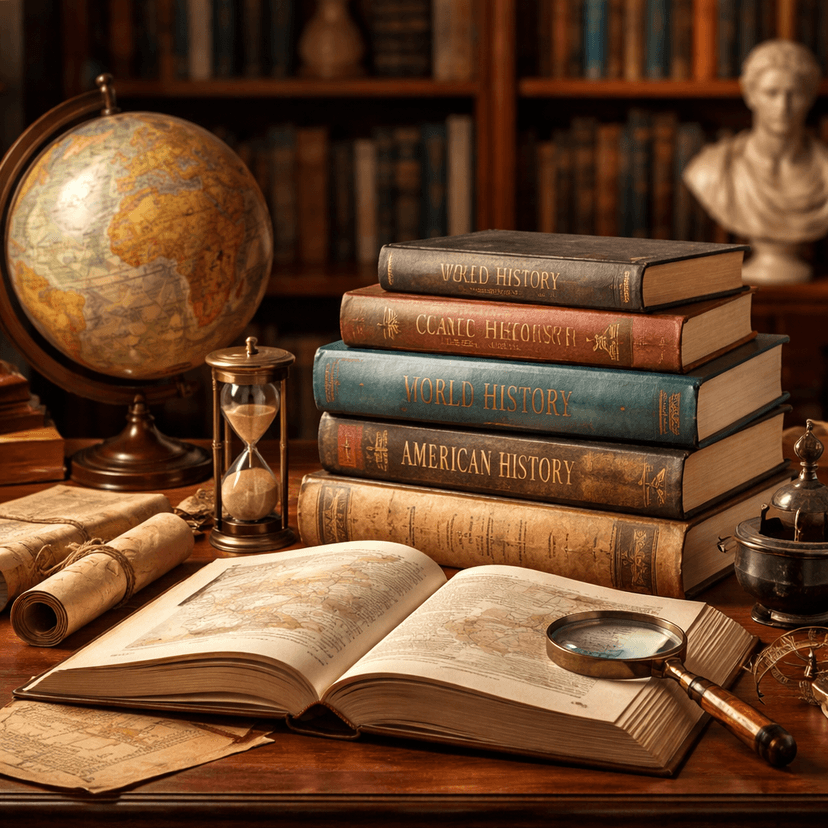
Looking for the best best history books? Our comprehensive guide covers everything you need to know about best history books.
The history of cartography is a fascinating tapestry woven with human curiosity, ambition, and the desire for understanding our place in the world. From the rudimentary drawings on cave walls to the sophisticated digital maps of today, the evolution of maps has not only transformed navigation but also shaped civilizations. This journey through cartographic history will uncover the milestones, innovations, and cultural shifts that have defined how we understand and represent our world.
The earliest known maps date back to prehistoric times, reflecting humanity's instinct to navigate and explore. One of the most famous examples is the Babylonian World Map, known as the Imago Mundi, which dates to the 6th century BCE. This clay tablet depicts a simplified view of the known world, showing Mesopotamia at its center, surrounded by various regions and bodies of water.
In ancient cultures, maps served not just as navigational tools but also as representations of cosmology. For instance, the Egyptians used maps to illustrate the afterlife, while the Greeks began to create more systematic maps, thanks to the work of thinkers like Anaximander and Ptolemy.
The Greeks significantly advanced cartographic knowledge. Ptolemy's "Geographia," written in the 2nd century CE, compiled and synthesized the geographical knowledge of the ancient world. Ptolemy introduced the concepts of latitude and longitude, allowing for a more precise representation of locations. His maps, however, were not without flaws; they were based on estimates and sometimes misinterpretations of distances, but they set the foundation for future cartographic endeavors.
During the Middle Ages, maps often served a dual purpose: they were both practical navigational tools and instruments of moral instruction. The mappa mundi, or medieval world map, depicted not just geography but also the prevailing religious beliefs of the time. One of the most notable examples is the Hereford Mappa Mundi, created in England around 1300.
This map illustrates not only the known world but also includes biblical narratives, mythical creatures, and moral lessons, emphasizing the importance of faith and the divine order of the universe. The map places Jerusalem at the center, reflecting the religious significance of the city in medieval thought.
The Islamic Golden Age (8th to 14th centuries) marked a significant period of scientific and cultural flourishing, leading to remarkable advancements in cartography. Scholars like Al-Idrisi, who worked for the Norman King Roger II of Sicily, created detailed world maps based on extensive travel and exploration. His map, known as the Tabula Rogeriana, was one of the most accurate depictions of the world at that time, illustrating the input of diverse cultures and knowledge from across the Islamic world.
The 15th and 16th centuries heralded the Age of Exploration, a period characterized by daring voyages and the quest for new <a href="/blog/the-spice-trade-how-flavors-shaped-world-history">trade</a> routes. Innovations in navigational tools, such as the magnetic compass and the astrolabe, along with improvements in ship design, facilitated long-distance travel. As explorers like Christopher Columbus and Ferdinand Magellan ventured into uncharted waters, the need for accurate maps intensified.
Cartographers emerged as critical figures during this era, tasked with translating explorers' findings into usable maps. One notable cartographer was Gerhard Mercator, who introduced the Mercator Projection in 1569. This cylindrical map projection revolutionized navigation by allowing sailors to plot straight lines on a flat surface, crucial for long sea voyages. However, the projection distorted landmasses, particularly near the poles, leading to misconceptions about the size of countries and continents.
The invention of the printing press in the mid-15th century dramatically changed map production. Maps could now be reproduced in larger quantities, making them more accessible to a broader audience. Notable maps from this period include Waldseemüller's World Map of 1507, which was the first to use the name "America" for the newly discovered continent, reflecting the burgeoning European interest in the New World.
The Age of Enlightenment in the 17th and 18th centuries brought about significant scientific advancements, further refining cartography. The establishment of longitude as a critical factor in navigation led to the development of more precise chronometers. This period also saw the rise of topographic mapping, where more attention was given to physical features of the landscape.
One of the most ambitious cartographic projects was the Great Trigonometrical Survey initiated by the British in the late 18th century. The survey aimed to measure the entire Indian subcontinent with remarkable precision. This project not only produced highly accurate maps but also contributed to advances in geodesy and the understanding of the Earth’s shape.
As nations began to form distinct identities, maps became tools of nationalism. They were used to assert territorial claims and foster a sense of unity among citizens. National maps reflected the political boundaries of nations, often emphasizing heroic narratives of exploration and conquest, for instance, in the case of the United States, which produced maps that highlighted Manifest Destiny.
The 19th century was a period marked by colonial expansion. Maps created during this era often reflected imperial ambitions, as European powers laid claim to vast territories in Africa and Asia. The Berlin Conference of 1884-1885, which regulated European colonization of Africa, was accompanied by the production of maps that delineated territorial boundaries with little regard for ethnic and cultural considerations.
The late 19th century also saw the emergence of thematic maps, which focused on specific data rather than geographic representation. These maps visualized social, economic, and environmental factors, reflecting a growing interest in statistics and data analysis. One of the pioneers of thematic mapping was Charles Minard, whose flow map of Napoleon’s 1812 Russian campaign is celebrated for its portrayal of troop movements and losses.
Both World Wars underscored the importance of cartography in military operations. Maps were indispensable for strategic planning, troop movements, and logistics. The use of aerial reconnaissance and satellite imagery during and after these conflicts revolutionized map-making, leading to more accurate and detailed representations of terrain.
The advent of computers in the late 20th century transformed cartography once more. Geographic Information Systems (GIS) allowed for the analysis and visualization of spatial data in ways previously unimaginable. This technology made it possible to create interactive maps that could be updated in real-time, facilitating urban planning, disaster response, and environmental management.
The proliferation of the internet in the 21st century ushered in a new era of mapping with online services like Google Maps and OpenStreetMap. These platforms democratized access to maps, enabling anyone with an internet connection to explore the world. The ability to layer information, such as traffic data or points of interest, has radically changed how we interact with geographic information.
As we look to the future, the role of cartography continues to evolve. With the rise of big data and machine learning, maps will increasingly be informed by real-time data and predictive analytics. The integration of augmented reality (AR) and virtual reality (VR) is likely to redefine how we navigate and perceive space, offering immersive experiences that blend the physical and digital worlds.
The journey through cartographic history reveals not only a fascinating evolution of mapping techniques but also a reflection of human civilization itself. Maps are not mere representations of geography; they tell stories of exploration, conquest, cultural identity, and technological innovation. They shape our understanding of the world and influence how we perceive our place within it.
As we continue to explore new frontiers, both terrestrial and digital, the spirit of cartography remains alive, reminding us that the quest for knowledge and understanding is a journey without end. The maps of tomorrow will undoubtedly continue to reflect the complexities and wonders of our ever-changing world, guiding future generations on their own explorations and discoveries.
---
This blog post not only covers the history of cartography but also emphasizes its significance in shaping human understanding of geography and navigation. By exploring key milestones and technological advancements, we see how maps have evolved in response to human needs and aspirations. As we advance into a digitally driven age, the art and science of mapping will remain a vital part of our collective journey into the future.
