From the first fraction of a second to the cosmos we see today
10
Episodes
4h 30m
Total Time
Beginner
Level
The Big Bang theory is the prevailing scientific explanation for the origin of the universe. Approximately 13.8 billion years ago, all matter, energy, space, and time emerged from an incredibly hot, dense state and has been expanding and cooling ever since.
Common misconceptions about the Big Bang abound:
The Big Bang didn't happen somewhere in the universe—the Big Bang was the universe at its earliest moment.
The most compelling evidence is the CMB—the "afterglow" of the Big Bang:
Edwin Hubble discovered that galaxies are moving apart:
The Big Bang predicts specific ratios of hydrogen, helium, and lithium:
Looking at distant galaxies means looking back in time:
This remains one of the deepest mysteries:
These remain hypotheses—we may never know what, if anything, preceded our universe.
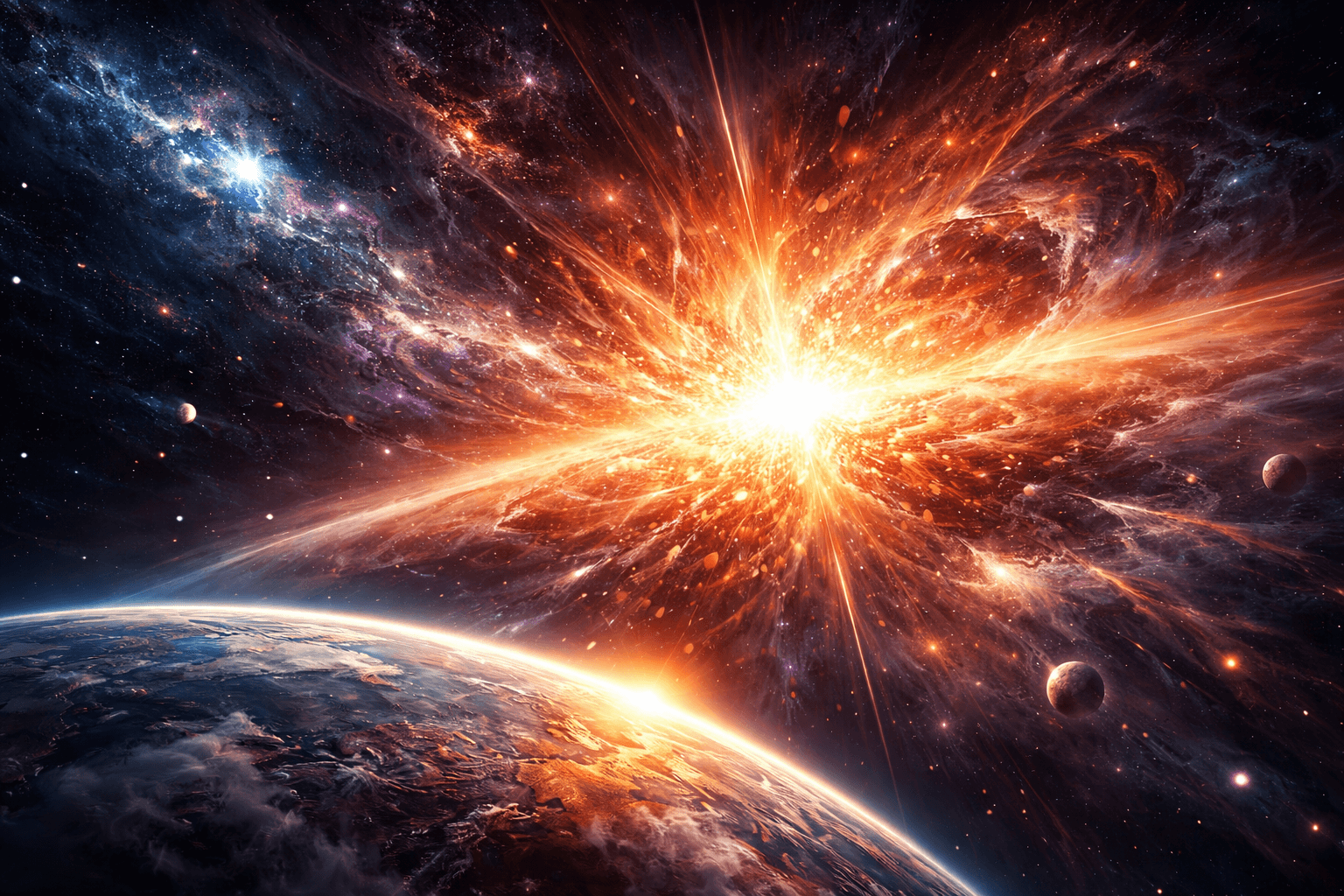
From the first fraction of a second to the cosmos we see today
10 audio lessons • 270 minutes total
The Big Bang explained simply. Common misconceptions (not an explosion in space). What the theory claims and doesn't claim. Brief history of the idea from Lemaître to today.
The expanding universe (Hubble's discovery). Cosmic microwave background radiation. Abundance of light elements. Large-scale structure of the universe. Why scientists are confident.
The Planck epoch and the limits of physics. Cosmic inflation: what it is and why it matters. The end of inflation and reheating. Why we can't see before inflation.
Coming soon
Quarks, leptons, and bosons in the early universe. Matter-antimatter asymmetry. The formation of protons and neutrons. The quark-gluon plasma.
How hydrogen, helium, and lithium formed in the first minutes. Why heavier elements weren't made. The predicted ratios and their confirmation.
Coming soon
The universe becomes transparent. The last scattering surface. What the CMB tells us. COBE, WMAP, and Planck observations.
Coming soon
Hundreds of millions of years of darkness. The formation of the first stars (Population III). Reionization of the universe. The first galaxies.
Coming soon
How dark matter shaped cosmic structure. The discovery of accelerating expansion. Dark energy and the cosmological constant. The composition of the universe.
Coming soon
Steady State theory (and why it failed). Cyclic universe models. String cosmology. What observations could challenge the Big Bang. Open questions.
Does 'before' the Big Bang make sense? Multiverse hypotheses. Eternal inflation. Quantum cosmology. The limits of scientific inquiry. Philosophy meets physics.
Coming soon
Master the laws of the universe through engaging audio lessons — from Newton to Einstein
Explore the universe from your earbuds — stars, planets, galaxies, and the mysteries of space
Explore the most mysterious objects in the cosmos — where physics breaks down
Discover everything about evidence for big bang. Expert insights, practical knowledge, and compelling facts you need to know.
What happened before big bang? Explore the mind-bending physics, theories, and paradoxes surrounding the ultimate cosmic mystery.
Master big bang theory explained with The Big Bang Theory: A Simple Explanation of How the Universe Began. Expert insights and analysis.
Transform your commute, workout, or downtime into learning time. Our AI-generated audio makes complex topics accessible and engaging.
Related topics:
