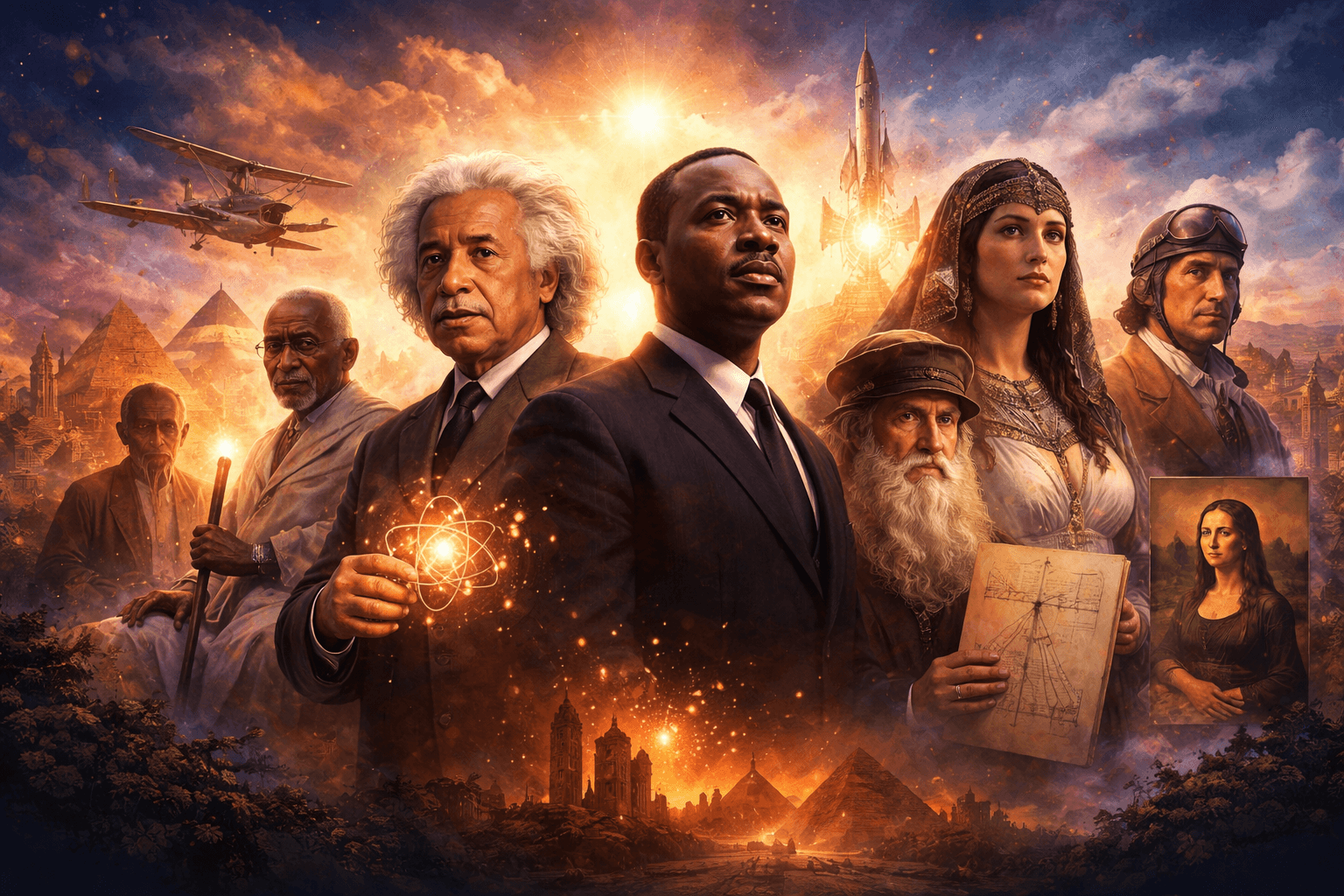
Why Read Biographies?
Biographies offer more than entertainment—they're windows into how remarkable people thought, struggled, failed, and ultimately achieved. Through others' lives, we gain perspective on our own possibilities and challenges. Great biographies show that extraordinary accomplishments come from ordinary humans who persisted when others quit.
What Great Biographies Reveal
The best biographies show:- How success really happens: Rarely a straight line; often through failure, rejection, and setback
- The cost of achievement: Sacrifices, broken relationships, health problems, suffering along the way
- Character in action: Values tested by real circumstances, not just proclaimed in comfort
- Historical context: How times shape people and people shape times
- Human nature: Patterns that transcend eras and cultures—ambition, fear, love, rivalry
- The messiness of greatness: Flaws coexisting with genius; contradictions within individuals
Scientists Who Changed Our Understanding
Albert Einstein (1879-1955)
Revolutionized physics with relativity and quantum theory:- Patent clerk who overturned Newton's worldview at age 26
- Special and general relativity reshaped our understanding of space, time, and gravity
- E=mc² revealed that mass and energy are equivalent
- Refugee from Nazi Germany who spent final years at Princeton
- Became synonymous with genius itself—the archetypal scientist
- His failures (unified field theory, rejecting quantum mechanics) as instructive as successes
- Explore Einstein's life →
Marie Curie (1867-1934)
Pioneer of radioactivity research:- First woman to win a Nobel Prize—then won a second in a different science (physics and chemistry)
- Discovered polonium (named for her native Poland) and radium
- Died from aplastic anemia caused by radiation exposure from her own research
- Fought sexism throughout her career, denied French Academy membership because of gender
- Her laboratory notebooks remain radioactive today—researchers must sign waivers to view them
- Raised two daughters while revolutionizing science—daughter Irène also won Nobel Prize
Charles Darwin (1809-1882)
Developed the theory of evolution by natural selection:- Five-year voyage on HMS Beagle transformed his thinking
- Spent 20+ years gathering evidence before publishing, fearing controversy
- Wrestled deeply with implications for religion and society
- On the Origin of Species (1859) changed biology forever
- Remarkably humble and self-doubting about his revolutionary ideas
- Showed how careful observation leads to transformative insight
Isaac Newton (1643-1727)
Laid the foundations of modern physics and mathematics:- Laws of motion and universal gravitation
- Invented calculus (simultaneously with Leibniz, leading to bitter priority dispute)
- Optics: proved white light is composed of colors
- "If I have seen further, it is by standing on the shoulders of giants"
- Difficult personality, bitter rivalries, strange obsessions (alchemy, biblical chronology)
- Demonstrated that genius can coexist with pettiness
Leaders Who Shaped History
Julius Caesar (100-44 BCE)
Military genius who ended the Roman Republic:- Conquered Gaul, crossed the Rubicon, won civil war
- Dictator who reformed Roman society—calendar, citizenship, debt relief
- Assassinated on the Ides of March by senators claiming to save freedom
- His death triggered the end of the Republic and birth of the Empire
- His heir Octavian became Augustus, first emperor
- His name became a title (Caesar, Kaiser, Tsar)
- Explore Caesar's life →
Abraham Lincoln (1809-1865)
Preserved the United States and ended slavery:- Rose from frontier poverty to presidency through self-education
- Self-taught lawyer who became brilliant orator
- Led through Civil War despite devastating losses and personal depression
- Emancipation Proclamation freed slaves in Confederate territory
- Gettysburg Address redefined American purpose in 272 words
- Assassinated at war's end, martyred into legend
- Showed that character matters more than credentials
Winston Churchill (1874-1965)
Led Britain through World War II:- "We shall fight on the beaches" speeches rallied the nation when defeat seemed certain
- Failures and comebacks throughout long career (Gallipoli disaster, wilderness years)
- Predicted Nazi danger when others sought appeasement
- Nobel Prize in Literature for historical writings
- Controversial colonial views and policies complicate legacy
- Proved that resolve can sustain nations through darkness
Mahatma Gandhi (1869-1948)
Led India to independence through nonviolence:- Developed satyagraha (nonviolent resistance, "truth force")
- Salt March and other campaigns challenged British rule
- Inspired civil rights movements worldwide (MLK, Mandela)
- Lived simply despite enormous influence—spinning cloth, fasting
- Assassinated by extremist who opposed his tolerance toward Muslims
- Showed that moral authority can defeat empires
Innovators Who Built the Future
Steve Jobs (1955-2011)
Transformed computing, music, and phones:- Co-founded Apple in a garage with Steve Wozniak
- Fired from his own company at 30, then returned to save it
- Created Macintosh, iPod, iPhone, iPad—each transformed its category
- Built Pixar into animation powerhouse
- Obsessive focus on design and user experience
- Proved that technology can be beautiful and that vision can reshape industries
- Explore Jobs' life →
Leonardo da Vinci (1452-1519)
Ultimate Renaissance polymath:- Artist: Mona Lisa, The Last Supper, Vitruvian Man
- Scientist: Anatomical studies ahead of his time, engineering designs
- Inventor: Concepts for flying machines, tanks, solar power, bridges
- Notebooks reveal limitless curiosity spanning all human knowledge
- Illegitimate birth, largely self-taught, never completed formal education
- Defined what human potential could achieve when curiosity is unlimited
Nikola Tesla (1856-1943)
Invented the modern electrical age:- AC electrical systems that power our world today
- Radio, remote control, wireless power transmission
- Over 300 patents across multiple countries
- Visionary concepts far ahead of his time
- Lost priority dispute with Marconi (later reversed)
- Died in obscurity despite transformative contributions
- Recently recognized as one of history's greatest inventors
Benjamin Franklin (1706-1790)
Founding Father and Renaissance man:- Lightning rod, bifocals, Franklin stove, Gulf Stream mapping
- Proved lightning was electrical (kite experiment)
- Diplomat who secured French alliance in Revolutionary War
- Self-made from humble origins, became international celebrity
- Witty writer (Poor Richard's Almanack)
- Combined practical invention with political genius
Artists Who Moved Humanity
Frida Kahlo (1907-1954)
Transformed suffering into transcendent art:- Devastating bus accident at 18 shaped her life—chronic pain, multiple surgeries
- Paintings explored pain, identity, Mexican culture, female experience
- Icon of feminism and perseverance
- Marriage to Diego Rivera—passionate, turbulent, mutually unfaithful
- Recognition grew dramatically after her death
- Proved art can emerge from adversity and that suffering can become creation
Ludwig van Beethoven (1770-1827)
Composed masterpieces while going deaf:- Bridged Classical and Romantic eras in music
- Nine symphonies including the transcendent Ninth with "Ode to Joy"
- Composed his greatest works after losing hearing—the late quartets, Ninth Symphony
- Symphony as personal expression began with him
- Struggled with health, relationships, family, finances throughout life
- Ultimate example of triumph over adversity
William Shakespeare (1564-1616)
Shaped the English language and literature:- 37 plays, 154 sonnets that have never gone out of print or performance
- Created countless phrases we still use (break the ice, wild goose chase, heart of gold)
- Explored human nature with unmatched psychological insight
- Rose from modest origins in Stratford to theatrical success in London
- Works performed continuously for 400+ years across all cultures
- Most influential writer in English, possibly in any language
What Makes Great Biography Writing
The best biographies share qualities:- Primary sources: Letters, diaries, interviews with contemporaries, archival research
- Context: Understanding the world the subject inhabited—not judging past by present standards
- Complexity: Showing flaws alongside greatness; avoiding hagiography
- Narrative skill: Making history compelling; telling stories, not just listing facts
- Judgment: Fair assessment of achievements and failures; acknowledging what we cannot know
- Prose quality: Writing that matches the subject's significance
Lives That Inspire
Reading biographies helps us:- See possibility in our own circumstances—these people were once ordinary too
- Learn from others' mistakes without paying the price ourselves
- Understand that great achievements require struggle—no success without setback
- Connect to human experience across time and culture
- Find role models for specific virtues (courage, persistence, creativity)
- Recognize cautionary tales (hubris, obsession, cruelty)
- Appreciate that extraordinary people are still people—flawed, uncertain, human
Related Biographies