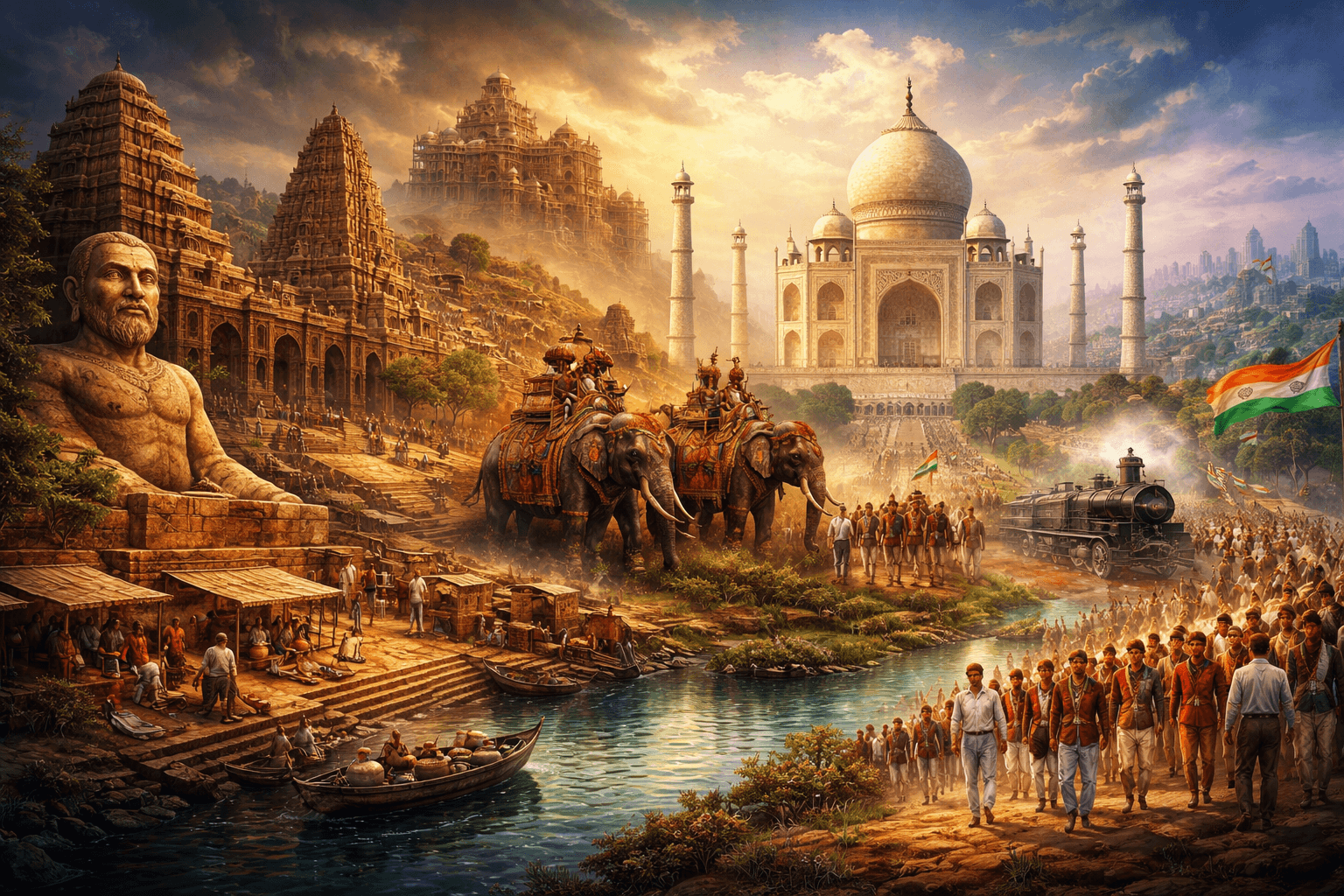
History of India: 5,000 Years of Civilization
India's history spans from one of humanity's earliest civilizations to the world's largest democracy. This subcontinent has produced major religions, mathematical innovations, and rich cultural traditions that continue to influence the world. With 1.4 billion people, India is both ancient and urgently modern.
Why Indian History Matters
India's contributions to civilization are immense:- Major religions: Hinduism, Buddhism, Jainism, Sikhism
- Mathematics: Zero, decimal system, algebra
- Philosophy: Profound traditions influencing global thought
- Art and architecture: From ancient temples to Mughal masterpieces
- Democracy: World's largest, testing self-government at scale
Understanding India is essential for understanding human history.
Ancient India
Indus Valley Civilization (c. 3300-1300 BCE)
One of the world's first urban civilizations:
Major Cities- Mohenjo-daro and Harappa (in modern Pakistan)
- Sophisticated urban planning with grid streets
- Advanced drainage systems, public baths
- Multi-story brick buildings
Achievements- Standardized weights and measures
- Trade networks reaching Mesopotamia
- Impressive craftsmanship
- Writing system (still undeciphered)
Mysterious Decline- Civilization faded around 1300 BCE
- Possible causes: climate change, river shifts, invasion
- No definitive answer
Learn about other ancient civilizations →
Vedic Period (c. 1500-500 BCE)
Indo-Aryan migration brought new culture:
The Vedas- Sacred texts, oldest scriptures in any Indo-European language
- Religious hymns, philosophical speculation
- Foundation of Hinduism
- Composed in Sanskrit
Social Organization- Varna (caste) system emerged
- Brahmins (priests), Kshatriyas (warriors), Vaishyas (merchants), Shudras (laborers)
- Later hardened into rigid caste hierarchy
- Debates about origins continue
Religious Development- Early Hinduism took shape
- Rituals, sacrifices, priesthood
- Philosophical Upanishads explored ultimate reality
- Concepts of karma, dharma, moksha developed
The Age of Empires
Maurya Empire (322-185 BCE)
India's first great empire:- Chandragupta Maurya: Founded the empire after Alexander's invasion
- Chanakya (Kautilya): Authored Arthashastra on statecraft
- Ashoka the Great: One of history's greatest rulers
Ashoka's Transformation- Conquered Kalinga in brutal war
- Horrified by bloodshed, embraced Buddhism
- Promoted non-violence, religious tolerance, welfare
- Rock and pillar edicts spread Buddhist teachings
- Model for later rulers
Gupta Empire (320-550 CE)
Golden Age of India:- Classical Sanskrit literature flourished
- Mathematics: Aryabhata calculated pi, proposed Earth's rotation
- Decimal numeral system developed
- Zero conceptualized
- Astronomy, medicine, metallurgy advanced
- Art and sculpture reached heights
- Visited by Chinese pilgrim Faxian
Medieval India
The Arrival of Islam
Muslim rulers transformed the subcontinent:
Early Invasions- Arab conquest of Sindh (711 CE)
- Mahmud of Ghazni's raids (1000-1027)
- Muhammad of Ghor's conquests (late 12th century)
Delhi Sultanate (1206-1526)
Five successive dynasties ruled from Delhi:- Slave Dynasty: Former slave generals
- Khalji Dynasty: Expanded south
- Tughlaq Dynasty: Overextension and chaos
- Sayyid and Lodi Dynasties: Weakening power
Cultural Synthesis- Indo-Islamic architecture emerged
- Persian became court language
- New art forms, music, cuisine
- Religious tension and cooperation
- Bhakti and Sufi movements sought spiritual unity
The Mughal Empire (1526-1857)
India's most famous dynasty:
The Great Mughals
Babur (r. 1526-1530)- Descended from Timur and Genghis Khan
- Defeated Delhi Sultanate at Panipat
- Founded the empire
Akbar (r. 1556-1605)- Greatest Mughal ruler
- Religious tolerance (Din-i-Ilahi synthesis)
- Administrative genius
- Patronized arts, welcomed all religions at court
Jahangir (r. 1605-1627)- Connoisseur of art
- His wife Nur Jahan wielded significant power
Shah Jahan (r. 1628-1658)- Built the Taj Mahal for his wife Mumtaz
- Magnificent architecture: Red Fort, Jama Masjid
- "If there is paradise on earth, it is here"
Aurangzeb (r. 1658-1707)- Expanded empire to greatest extent
- Religious conservatism alienated Hindus
- Constant wars exhausted treasury
- Empire began declining after his death
Mughal Decline- Weak successors after Aurangzeb
- Maratha Confederacy rose
- Regional powers fragmented the empire
- British East India Company gained control
Colonial India
European Arrival
Trading companies became conquerors:
Portuguese (arrived 1498)- First Europeans to reach India by sea
- Controlled Goa and coastal enclaves
British East India Company- Established trading posts (1600s)
- Won Battle of Plassey (1757)
- Gradually conquered the subcontinent
- Exploited local divisions
The Rebellion of 1857
Also called the "Sepoy Mutiny" or "First War of Independence":- Indian soldiers (sepoys) rebelled
- Spread across north India
- Brutally suppressed
- British Crown took direct control from Company
The British Raj (1858-1947)
Imperial rule transformed India:
Changes- Railways, telegraph, modern administration
- English education created new elite
- Legal system reformed
- Infrastructure developed (for British benefit)
Exploitation- Economic drain to Britain
- Deindustrialization of textile industry
- Famines killed millions (especially 1943 Bengal famine)
- Racial discrimination and humiliation
Independence Movement Emerged- Indian National Congress (1885)
- Muslim League (1906)
- Growing demands for self-rule
The Freedom Struggle
Key Leaders and Movements
Mahatma Gandhi (1869-1948)- Developed satyagraha (nonviolent resistance)
- Salt March (1930): Iconic civil disobedience
- Quit India Movement (1942)
- Became "Father of the Nation"
Jawaharlal Nehru (1889-1964)- Gandhi's political heir
- First Prime Minister of independent India
- Shaped modern India's democratic institutions
Subhas Chandra Bose (1897-1945?)- Advocated armed struggle
- Led Indian National Army with Japanese support
- Died mysteriously at war's end
Muhammad Ali Jinnah (1876-1948)- Led Muslim League
- Advocated for Pakistan
- Became Pakistan's founder ("Quaid-i-Azam")
B.R. Ambedkar (1891-1956)- Champion of Dalits (untouchables)
- Chief architect of India's Constitution
- Converted to Buddhism
Partition (1947)
Independence came with tragedy:- British India divided into India and Pakistan
- Massive population transfers (14-15 million)
- Hindu-Muslim violence killed 1-2 million
- Kashmir dispute began
- Communal trauma persists
Modern India
Republic of India (1950-Present)
Nehruvian Era- Democratic constitution
- Secular state
- Planned economy, state-led development
- Non-alignment in Cold War
Later Developments- Wars with China (1962) and Pakistan (1965, 1971)
- Green Revolution improved food security
- Economic liberalization (1991)
- Rise as global technology hub
- World's largest democracy
Challenges and Achievements
Challenges- Poverty and inequality
- Religious and caste tensions
- Border disputes with Pakistan and China
- Environmental degradation
Achievements- Sustained democracy despite diversity
- Nuclear power and space program
- Growing economy and middle class
- Cultural influence worldwide
India's story continues to unfold—a civilization ancient yet ever-renewing.
Related Topics