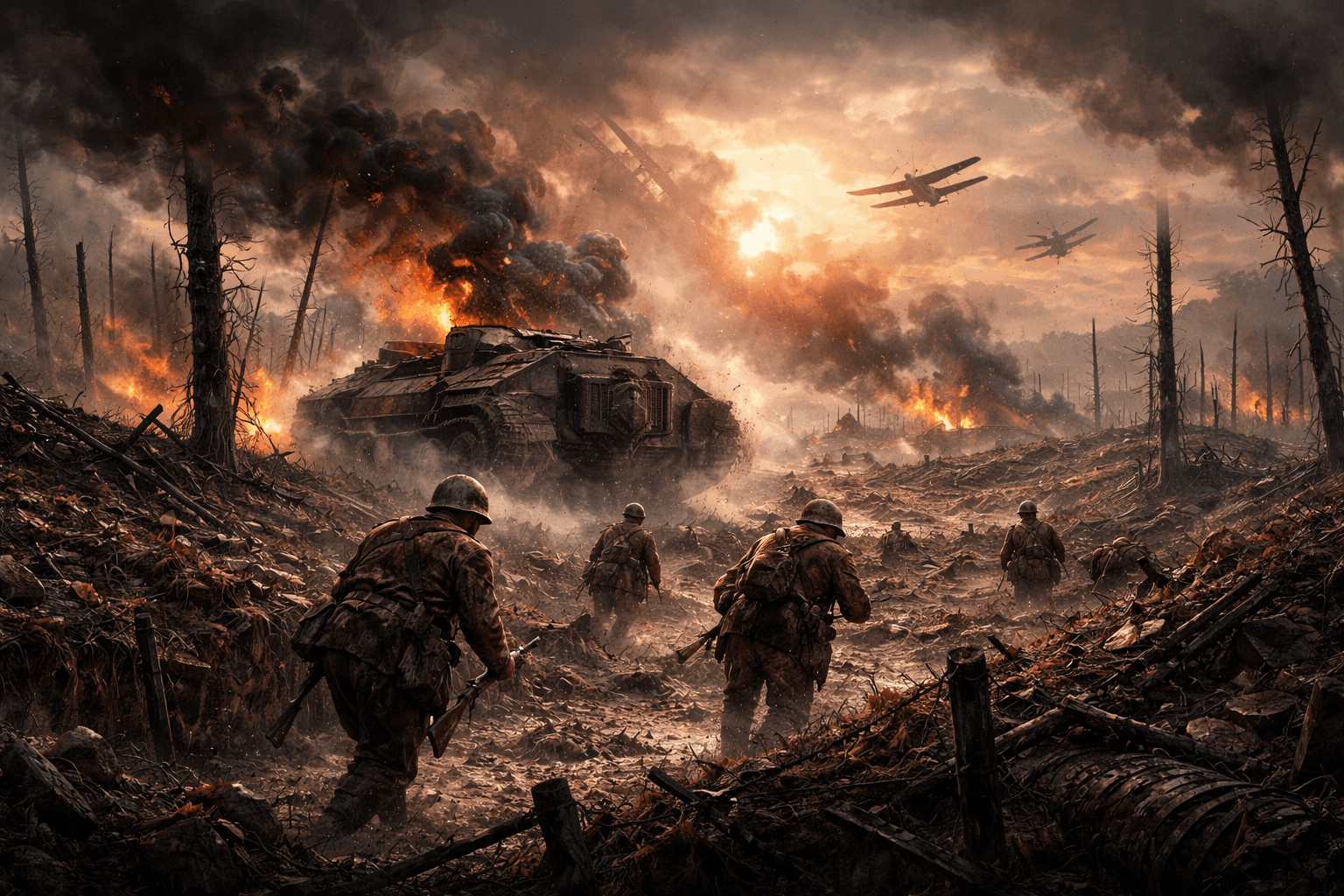
World War I: The War That Changed Everything
World War I (1914-1918) killed approximately 20 million people, destroyed four empires, and fundamentally reshaped the global order. Called "The Great War" by contemporaries who couldn't imagine anything worse, it created the conditions for an even greater catastrophe just two decades later.
Why World War I Matters
This conflict's consequences still shape our world:- Destroyed four empires: German, Austro-Hungarian, Ottoman, Russian
- Created new nations: Poland, Czechoslovakia, Yugoslavia, and more
- Caused World War II: Through punitive peace terms and economic chaos
- Birthed modern warfare: Tanks, aircraft, chemical weapons, total war
- Transformed society: Women's roles, class structures, political ideologies
Causes of the War
Long-Term Tensions
Europe in 1914 was a powder keg waiting to explode:
Alliance System- Triple Entente: Britain, France, Russia
- Triple Alliance: Germany, Austria-Hungary, Italy
- A local conflict could trigger a continental war
Imperial Rivalries- Competition for colonies in Africa and Asia
- Germany sought its "place in the sun"
- Clashing interests in declining Ottoman territories
Arms Race- German naval buildup challenged British supremacy
- Military budgets soared across Europe
- New weapons developed: machine guns, artillery, submarines
Nationalism- Balkans: "Powder keg of Europe" with ethnic tensions
- Pan-Slavism vs. Austro-Hungarian control
- French desire for revenge over Alsace-Lorraine (lost in 1871)
Learn about the German Empire's role →
The Spark: Sarajevo
June 28, 1914, changed everything:- Archduke Franz Ferdinand (Austro-Hungarian heir) assassinated in Sarajevo
- Killed by Gavrilo Princip, a Bosnian Serb nationalist
- Austria-Hungary blamed Serbia
- Germany gave Austria a "blank check" of support
- Russia mobilized to support Serbia
- Alliance obligations pulled in the great powers
- By August, all of Europe was at war
The Belligerents
Allied Powers (Entente)
Britain and the British Empire- World's largest navy
- Global empire provided resources and troops
- Entered when Germany invaded Belgium
France- Seeking revenge for 1871 defeat
- Bore enormous casualties on the Western Front
- Never surrendered despite devastating losses
Russia- Massive population ("the steamroller")
- Poor infrastructure and leadership
- Revolution in 1917 took Russia out of the war
Italy (joined 1915)- Originally allied with Germany and Austria
- Switched sides for territorial promises
- Fought Austria in the Alps
United States (joined 1917)- Initially neutral
- Unrestricted submarine warfare and Zimmermann Telegram prompted entry
- Fresh troops tipped the balance
Central Powers
Germany- Europe's strongest military and industrial power
- Planned to knock out France quickly, then turn on Russia
- Explore the German Empire →
Austria-Hungary- Multiethnic empire struggling to hold together
- Sparked the war but couldn't win it alone
- Collapsed in 1918
Ottoman Empire- "Sick man of Europe," declining but vast
- Entered hoping to reclaim lost territories
- Fought in Middle East, Gallipoli, Caucasus
Bulgaria (joined 1915)- Seeking territory lost in Balkan Wars
- Added southern front against Serbia and Romania
The Western Front
Trench Warfare: The Defining Horror
The Western Front became a horrific stalemate:
The Trenches- Lines stretched from Switzerland to the English Channel
- Soldiers lived in muddy, rat-infested ditches for months
- Disease and exposure killed as many as combat
- "No man's land" between trenches was death ground
Why Stalemate?- Defensive technology outpaced offensive tactics
- Machine guns could mow down advancing infantry
- Artillery warned defenders attacks were coming
- Barbed wire trapped attackers in kill zones
Explore WW1 weapons and technology →
Major Battles
First Battle of the Marne (1914)- Stopped German advance on Paris
- Ended hopes for quick victory
- Set stage for years of trench warfare
Verdun (1916)- 10-month German offensive
- Goal: "Bleed France white"
- ~700,000 combined casualties
- French held, barely
The Somme (1916)- British offensive to relieve Verdun
- 20,000 British dead on first day alone
- 1 million total casualties for minimal gains
- First use of tanks (limited impact)
Passchendaele (1917)- British offensive in Belgium
- Men drowned in mud-filled shell craters
- 500,000 casualties for 5 miles of ground
The Eastern Front
Different Character
More mobile than the Western Front:- Vast distances, fewer troops per mile
- Larger advances and retreats possible
- Still horrifically bloody
Tannenberg (1914)- German victory destroyed Russian Second Army
- 30,000 Russians killed, 92,000 captured
- Established German dominance in the East
Gorlice-Tarnów (1915)- German-Austrian breakthrough
- Russia pushed back hundreds of miles
- Massive Russian losses
Russian Collapse (1917)- February Revolution: Tsar abdicated
- Provisional government continued war unpopularly
- October Revolution: Bolsheviks took power
- Treaty of Brest-Litovsk (1918): Russia left the war
Other Theaters
Gallipoli (1915-1916)
Allied attempt to knock out Ottoman Empire
Capture Constantinople, open supply route to Russia
Disastrous failure with heavy casualties
Winston Churchill's plan—temporarily ruined his careerMiddle East
Lawrence of Arabia supported Arab Revolt
British captured Jerusalem, Baghdad
Ottoman Empire gradually dismemberedAfrica and Asia
German colonies attacked and captured
Japan seized German Pacific possessions
Minor but widespread fighting1917: The Turning Point
Russian Revolution
Removed one major Allied power
Released German troops for Western FrontAmerican Entry
German unrestricted submarine warfare brought US in
Fresh troops, industrial might, and finances
Morale boost for exhausted AlliesFrench Army Mutinies
After disastrous Nivelle Offensive
Soldiers refused suicidal attacks
French army nearly collapsed1918: The End
German Spring Offensive
Last gamble before American troops arrived in force
Initial successes, advances of 40+ miles
Exhausted German army couldn't sustain gainsAllied Counteroffensives
"Hundred Days Offensive" starting August 1918
Tanks, aircraft, and fresh American troops
German lines finally brokeCollapse
German home front starving from blockade
Navy mutinied at Kiel
Revolution spread through Germany
Kaiser Wilhelm II abdicated, fled
Armistice: November 11, 1918, 11:00 AMThe Peace
Treaty of Versailles
The peace terms for Germany were harsh:- War guilt clause: Germany accepted blame
- Reparations: Massive payments ($33 billion)
- Territory lost: Alsace-Lorraine, Polish Corridor, colonies
- Military restrictions: 100,000-man army, no air force, limited navy
- Created resentment that Hitler later exploited
New World Order
League of Nations founded (US didn't join)
New nations carved from empires
Mandate system for former colonies
Seeds of future conflicts plantedLegacy
World War I transformed everything:- Total war: Entire societies mobilized
- Technology: Tanks, aircraft, chemical weapons, radio
- Social change: Women in workforce, old hierarchies shattered
- Lost generation: Trauma, disillusionment, millions dead
- Future conflicts: WWII, Middle East tensions, Russian Revolution
The war to end all wars ended nothing—it only planted the seeds for more.
Related Topics