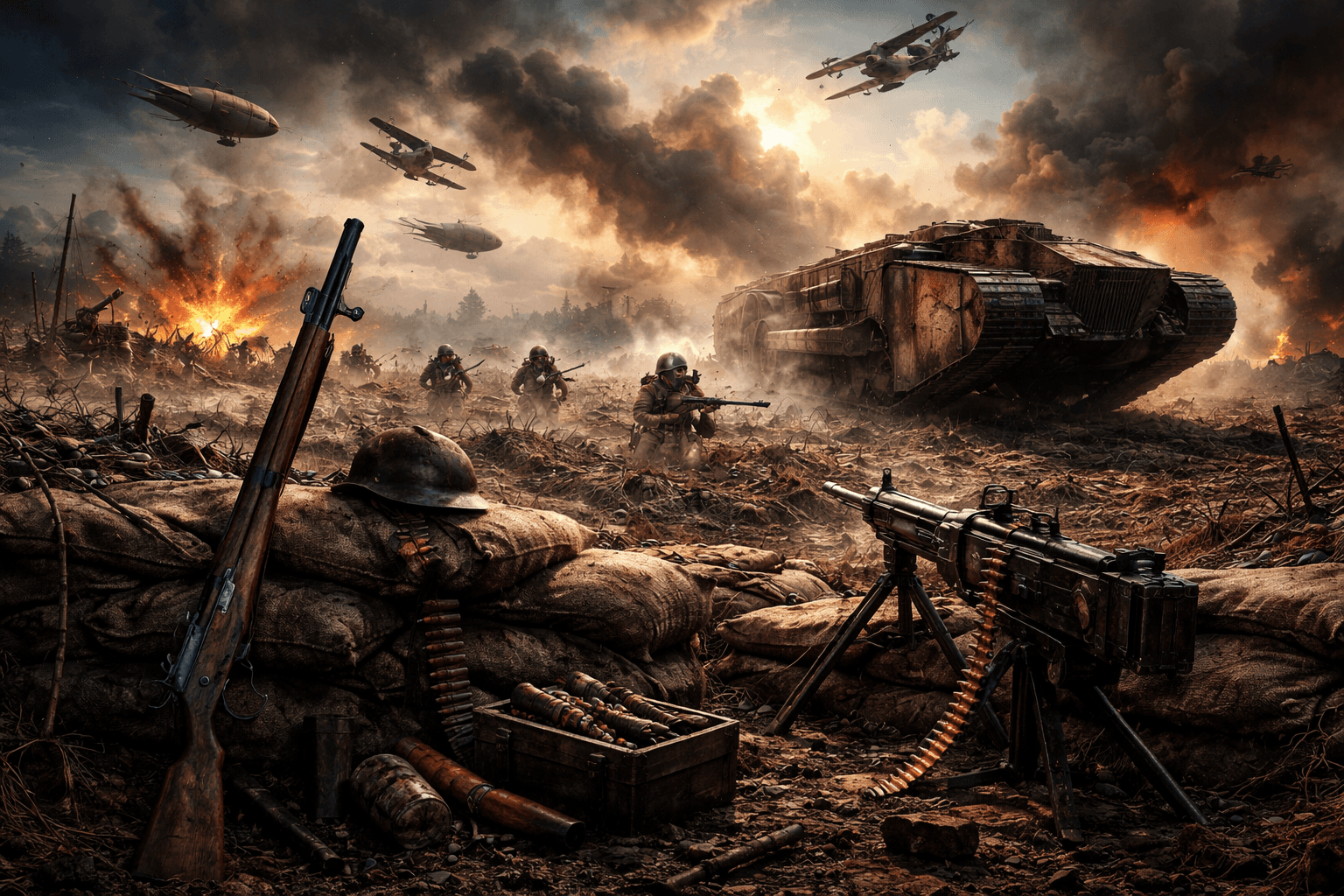
World War I: The First Industrial War
World War I (1914-1918) saw unprecedented technological killing. New weapons outpaced military doctrine, creating the horrific stalemate of trench warfare where millions died for yards of churned mud. This war transformed combat forever.
Why WW1 Technology Matters
The Great War demonstrated:- Industrial warfare: Mass production of weapons and munitions
- Defensive dominance: Technology favored defenders over attackers
- Doctrine lag: Tactics hadn't adapted to new weapons
- Desperate innovation: Four years of frantic weapons development
Explore the full history of World War 1 →
Infantry Weapons
The Machine Gun
Perhaps the defining weapon of WW1:
Characteristics- Rate of fire: 400-600 rounds per minute
- Water-cooled for sustained fire
- Required crews of 4-6 men
- Heavy, but devastating in defense
Tactical Impact- One gun could stop hundreds of attackers
- Made frontal assaults suicidal
- Created the trench stalemate
- Defense became much easier than offense
Major Models- Maxim gun (German MG 08)
- Vickers (British)
- Hotchkiss (French)
- Lewis gun (lighter, portable)
A single well-positioned machine gun could hold off entire battalions.
Rifles
Standard infantry weapons remained bolt-action:
Characteristics- Accurate to 500+ yards
- Trained soldiers: 15+ aimed shots per minute
- Bayonets for close combat
- Reliable in trench conditions
Major Types- Lee-Enfield (British): Fast action, 10-round magazine
- Gewehr 98 (German Mauser): Excellent accuracy
- Lebel (French): First smokeless powder rifle
Grenades
Essential for trench warfare:
Types- Mills Bomb (British): First modern fragmentation grenade
- Stielhandgranate (German): "Stick grenade" for throwing distance
- Improvised bombs: Early war used modified explosives
Use- Clearing trenches during raids
- Defensive against attackers
- Became standard infantry equipment
Artillery
The Great Killer
Artillery caused more WWI deaths than any other weapon:
Scale- Millions of shells fired in major battles
- Week-long bombardments before offensives
- Verdun: 40 million shells fired by both sides
Types- Field guns: Lighter, mobile support
- Howitzers: High-angle fire to hit trenches
- Siege artillery: Massive guns for fortifications
- Railway guns: Enormous cannons on rail cars
Effects- Destroyed trenches and fortifications
- Created shell-cratered moonscapes
- Caused "shell shock" (PTSD)
- But also warned defenders that attacks were coming
Creeping Barrage
Tactical innovation:- Artillery fire moved ahead of advancing troops
- Protected infantry from immediate counterfire
- Required precise timing and coordination
- Helped break the stalemate by 1918
Chemical Weapons
Poison Gas: A New Horror
WW1 introduced large-scale chemical warfare:
Chlorine (1915)- First major use at Second Ypres by Germany
- Caused panic, thousands of casualties
- Yellow-green cloud, choking death
- Countermeasure: Wet cloth over face (improvised)
Phosgene- More lethal than chlorine
- Harder to detect (smelled like hay)
- Delayed symptoms made it insidious
Mustard Gas (1917)- Caused horrific burns to skin, eyes, lungs
- Blistering agent, not just respiratory
- Lingered for days, contaminating ground
- No effective protection initially
Gas Masks- Rapidly developed and distributed
- Reduced gas effectiveness
- Soldiers carried masks constantly
- Still psychologically terrifying
Chemical weapons caused ~100,000 deaths and 1 million casualties—more terror than tactical impact.
Tanks
Breaking the Stalemate
Tanks were invented specifically to cross trenches:
First Use- British Mark I at the Somme (September 1916)
- "Land ships" to cross no man's land
- Crush barbed wire, span trenches
Characteristics- Slow (4 mph)
- Mechanically unreliable
- Hot, noisy, nauseating for crews
- Vulnerable to artillery
Evolution- Mark IV: Improved armor and reliability
- Whippet: Faster, for exploitation
- Renault FT: First modern tank layout (turret)
- German A7V: Only German tank (few produced)
Impact- Limited in WW1 (too few, too unreliable)
- Showed future potential
- Revolutionized WWII warfare
Aircraft
War Takes to the Sky
Aviation evolved rapidly during WW1:
Reconnaissance- Initial primary purpose
- Observing enemy positions and movements
- Directing artillery fire
- Transformed battlefield intelligence
Fighter Aircraft- Developed to deny enemy observation
- "Aces" became celebrity heroes
- Manfred von Richthofen ("Red Baron"): 80 victories
- Eddie Rickenbacker: Top American ace
Bombers- Strategic bombing began
- German Zeppelins and Gotha bombers hit Britain
- Psychological impact exceeded physical damage
Technology Evolution- 1914: Fragile, slow, unarmed
- 1918: Fast, maneuverable, heavily armed
- Synchronized machine guns firing through propeller
- Metal frames replacing wood
Naval Warfare
Submarines (U-boats)
Germany's most effective naval weapon:
Campaign- Targeted Allied shipping, especially to Britain
- Unrestricted submarine warfare: Sink anything in war zone
- Nearly starved Britain into submission
Consequences- Lusitania sinking (1915): Killed 1,198, including 128 Americans
- Major factor in US entry (1917)
- Convoy system eventually reduced losses
Surface Fleet
Battle of Jutland (1916)- Only major fleet action
- Inconclusive: British lost more ships, Germans retreated
- German fleet never seriously challenged again
Trench Warfare Technology
Barbed Wire
Simple but deadly:- Mass-produced, easy to deploy
- Slowed attackers under machine gun fire
- Required hours to cut through
- Defined no man's land
Trenches
Elaborate defensive systems:- Front line: Facing the enemy
- Support trenches: Behind front line
- Reserve trenches: Third line defense
- Communication trenches: Connecting them
- Dugouts: Underground shelters
Other Innovations
Periscopes: Seeing over the parapet safely
Flamethrowers: Terrifying close-combat weapon
Trench mortars: High-angle fire into enemy trenches
Steel helmets: Reduced head wounds dramaticallyCommunications
Telephone
Primary military communication:- Wired connections between trenches and headquarters
- Vulnerable to shell damage
- Required constant repair under fire
Radio (Wireless)
Still primitive:- Heavy, unreliable equipment
- Used more by navy and aircraft
- Would become crucial by WWII
Signals
Traditional methods persisted:- Runners carrying messages
- Signal flags and lamps
- Carrier pigeons (surprisingly effective)
Medical Technology
Treatment Advances
War drove medical innovation:- Blood transfusion: First practical use
- Antiseptics: Reduced infection deaths
- Anesthesia: Improved surgical survival
- Prosthetics: For millions of amputees
- Plastic surgery: Reconstructing faces
Shell Shock
PTSD recognized as medical condition:- Psychological trauma from combat
- Initially misunderstood
- Thousands suffered for life
Legacy
WW1 technology lessons:- Defense dominates until tactics adapt
- Technology without doctrine creates slaughter
- Innovation accelerates under existential pressure
- Total war mobilizes entire societies
These lessons—many learned at terrible cost—would shape WWII and beyond.
Related Topics