World War II: Technology Transforms Warfare
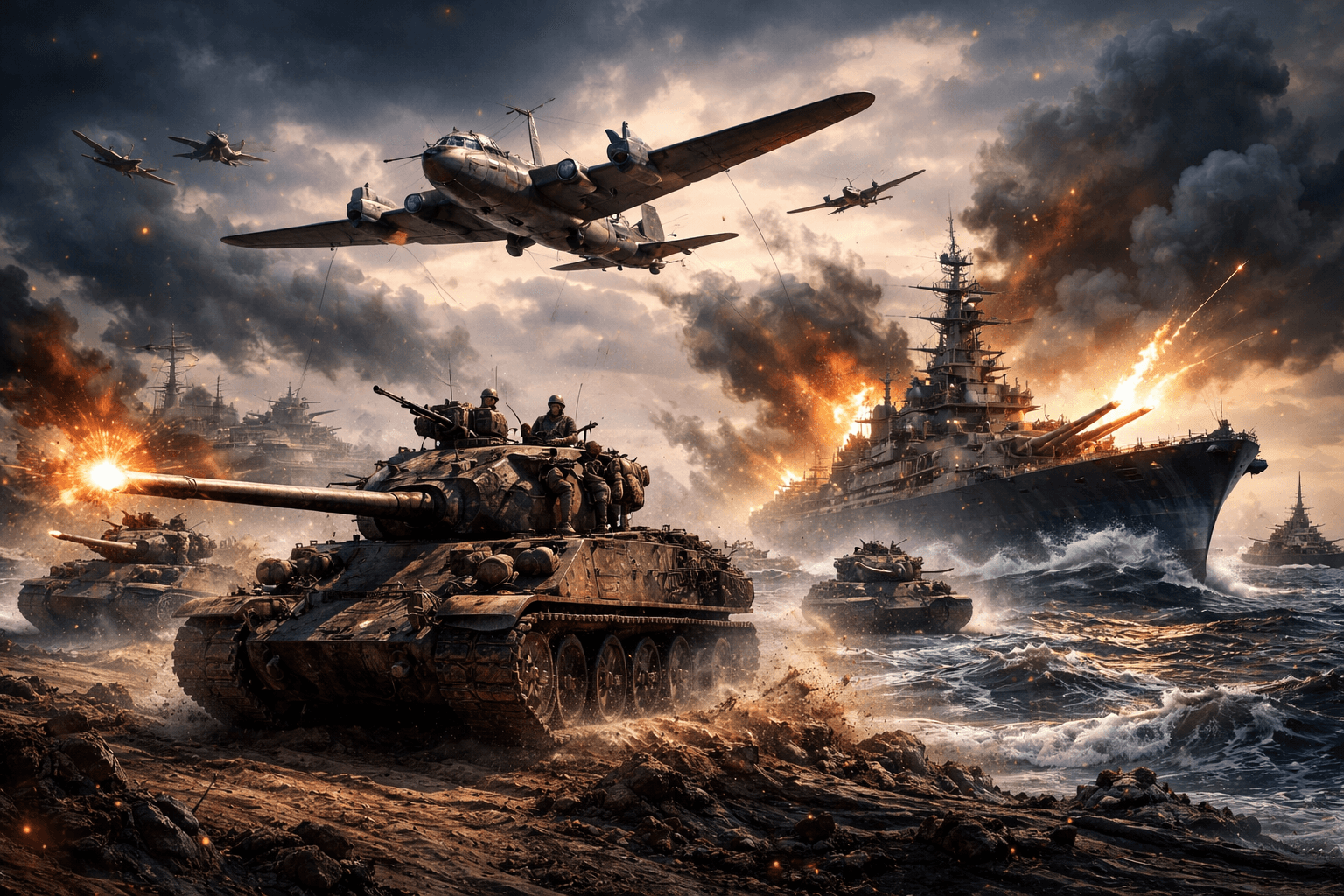
World War II (1939-1945) was history's most technologically advanced conflict. Innovations in tanks, aircraft, radar, and ultimately atomic weapons determined victory and shaped the modern world. The war accelerated technological development by decades.
The Technology Race
Both sides competed furiously for advantage:
- Radar: Gave Britain crucial edge in the Battle of Britain
- Code-breaking: Allied Ultra intelligence from Enigma machines
- Jet aircraft: Germans pioneered, Allies caught up
- Rockets: V-1 and V-2 foreshadowed missile age
- Nuclear weapons: War's most consequential development
Explore the full history of World War 2 →
Ground Warfare
Tanks: Mobile Armored Warfare
Tanks defined WWII land combat:
German Tanks
- Panzer III/IV: Early war workhorses, reliable and effective
- Tiger I: Feared heavy tank with 88mm gun, thick armor
- Panther: Excellent gun and armor, mechanical issues
- Tiger II (King Tiger): Massive but too heavy and rare
Soviet Tanks
- T-34: Possibly WWII's best all-round tank
- Sloped armor, wide tracks, reliable engine
- Produced in massive numbers (84,000+)
- KV-1: Heavy tank that shocked Germans in 1941
- IS-2: Late-war heavy tank matching Tigers
American Tanks
- M4 Sherman: Not the best, but produced in vast numbers (49,000)
- Reliable, easy to repair
- Outmatched by Tigers but available everywhere
- M26 Pershing: Better gun, arrived late in war
British Tanks
- Matilda: Heavily armored, slow
- Churchill: Infantry tank, climbed difficult terrain
- Cromwell: Fast cruiser tank
- Sherman Firefly: Sherman with 17-pounder gun
Tank Doctrine
How tanks were used mattered as much as their quality:
Blitzkrieg (German)
- Combined arms: Tanks, infantry, artillery, air support
- Concentrate armor for breakthrough
- Exploit with speed, encircle enemies
- Devastatingly effective in Poland, France, early Russia
Soviet Deep Operations
- Massive armored thrusts
- Breakthrough and exploitation
- Eventually mastered German techniques with greater resources
Infantry Weapons
Rifles
- M1 Garand (US): Semi-automatic gave firepower advantage
- Kar98k (German): Bolt-action, reliable
- Mosin-Nagant (Soviet): Simple, rugged bolt-action
Submachine Guns
- MP40 (German): "Schmeisser"
- Thompson/M3 Grease Gun (US)
- PPSh-41 (Soviet): Massive drum magazine
Assault Rifles
- StG 44 (German): First true assault rifle
- Pointed to future infantry weapons
- Selective fire, intermediate cartridge
Anti-Tank Weapons
- Bazooka (US): Infantry rocket launcher
- Panzerfaust (German): Disposable rocket
- PIAT (British): Spring-powered launcher
Air Power
Strategic Bombing
Air campaigns became decisive:
Allied Bombing of Germany
- RAF Bomber Command: Night area bombing
- USAAF Eighth Air Force: Daylight precision bombing
- Combined Bomber Offensive: Around-the-clock attacks
- Target: Industry, transportation, oil, cities
German Bombing
- Battle of Britain (1940): Failed to achieve air superiority
- The Blitz: Terror bombing of British cities
- V-weapons: Rockets and cruise missiles hit London
Pacific Air War
- B-29 Superfortress: Most advanced bomber of the war
- Firebombing of Japan: Killed more than atomic bombs
- Atomic missions: Enola Gay and Bockscar
Fighter Aircraft
Air superiority was crucial:
British Fighters
- Spitfire: Icon of Battle of Britain
- Hurricane: More numerous, equally important
- Typhoon/Tempest: Ground attack excellence
German Fighters
- Bf 109: Luftwaffe's primary fighter throughout war
- Fw 190: Excellent all-rounder
- Me 262: First operational jet fighter
American Fighters
- P-51 Mustang: Long-range escort made bombing sustainable
- P-47 Thunderbolt: Rugged, excellent ground attack
- P-38 Lightning: Twin-engine, long range
Soviet Fighters
- Yak-series: Lightweight, agile, effective
- La-5/7: Among the war's best fighters
- Designed for Eastern Front conditions
Japanese Fighters
- A6M Zero: Initially dominant, light and agile
- Lacked armor and self-sealing tanks
- Outclassed by later Allied designs
Naval Aviation
Aircraft carriers transformed naval warfare:
Pearl Harbor (1941)
- Demonstrated carrier power
- Battleship era essentially ended
Coral Sea and Midway (1942)
- First naval battles where ships never saw each other
- Aircraft decided everything
- Midway: Four Japanese carriers sunk
Naval Technology
Aircraft Carriers
Capital ships of WWII:
- Range: Strike from hundreds of miles
- Flexibility: Multiple mission types
- Vulnerability: Required extensive protection
Submarines
Both sides used submarines extensively:
German U-boats
- Wolf packs: Coordinated attacks on convoys
- Battle of the Atlantic: Nearly cut Britain's supply lines
- Defeated by radar, sonar, air patrols, code-breaking
American Submarines
- Devastated Japanese merchant fleet
- Cut off resources from conquered territories
- Key factor in Japan's defeat
Destroyers and Escorts
Anti-submarine warfare:
- Sonar/ASDIC: Detecting submerged submarines
- Depth charges: Attacking submarines
- Hedgehog: Forward-throwing anti-submarine weapon
- Convoy system: Protection in numbers
Revolutionary Technologies
Radar
Radio Detection and Ranging:
Capabilities
- Detected incoming aircraft at long range
- Crucial in Battle of Britain (gave warning)
- Ship-based radar for naval combat
- Ground-based for artillery direction
Chain Home
- British radar network
- Gave precious minutes of warning
- Arguably won the Battle of Britain
Code-Breaking
Intelligence advantage:
Enigma
- German cipher machine
- Cracked by Polish and British mathematicians
- Bletchley Park: Center of British code-breaking
Ultra
- Intelligence from decrypted Enigma messages
- Invaluable strategic and tactical advantage
- Kept secret until 1970s
Purple
- Japanese diplomatic cipher
- US broke it before Pearl Harbor
- Magic intelligence from decrypts
Rockets
Germany pioneered military rocketry:
V-1 Flying Bomb
- Cruise missile (pulse-jet powered)
- ~10,000 launched against Britain
- Could be shot down or tipped by aircraft
V-2 Ballistic Missile
- First long-range ballistic missile
- No defense possible
- ~3,000 launched against Britain and Belgium
- Precursor to space rockets and ICBMs
The Atomic Bomb
War's most consequential technology:
Manhattan Project
- $2 billion (1940s dollars)
- 125,000 workers
- Multiple secret sites
- Race against possible German bomb
Trinity Test (July 16, 1945)
- First nuclear explosion
- New Mexico desert
- "Now I am become Death, the destroyer of worlds" —Oppenheimer
Hiroshima and Nagasaki
- August 6 and 9, 1945
- ~200,000 dead (immediate and radiation)
- Japan surrendered August 15
- Nuclear age began
Medical and Other Advances
Penicillin
First antibiotic mass-produced for military
Saved countless lives from infection
Revolutionized medicineBlood Plasma
Storage and transfusion techniques perfected
Saved wounded who would have diedSynthetic Materials
Rubber shortage drove synthetic development
Nylon, plastics advanced rapidlyLegacy
WWII technology reshaped the world:
- Nuclear weapons: Cold War, MAD doctrine
- Rockets: Space race, ICBMs
- Radar: Air traffic control, weather
- Computing: Enigma-breaking → early computers
- Jet aircraft: Modern aviation
- Medical advances: Antibiotics, trauma care
The war compressed decades of innovation into six years, creating the technological foundation of the modern world.
Related Topics
World War 2 Complete Guide — The full conflict
WW1 Weapons and Technology — Previous war's innovations
GPT and AI Explained — Technology's continuing revolution
